Bathroom
Bath Volume / Litres Calculator
Calculates bath water volume in litres, UK gallons and US gallons from millimetre dimensions
Updated 28 May 2026 · Live
What this tool does
Calculates bath water volume from millimetre internal dimensions. Output is shown in litres, m³, UK gallons and US gallons, plus the heating energy to raise the water from 15°C to 40°C.
Bath Volume / Litres Calculator — estimates the water a bath holds from the internal dimensions and fill factor you enter.
People also use
Formula Used
How the bath volume / litres calculator works
Calculates bath volume in litres or gallons from bath dimensions. It multiplies internal length, width and fill depth, then trims the result with a fill factor for the bath's sloped sides and the gap below the overflow, giving the volume in litres and gallons. Every figure is an estimate — bath shape and how full the bath is run move the real number.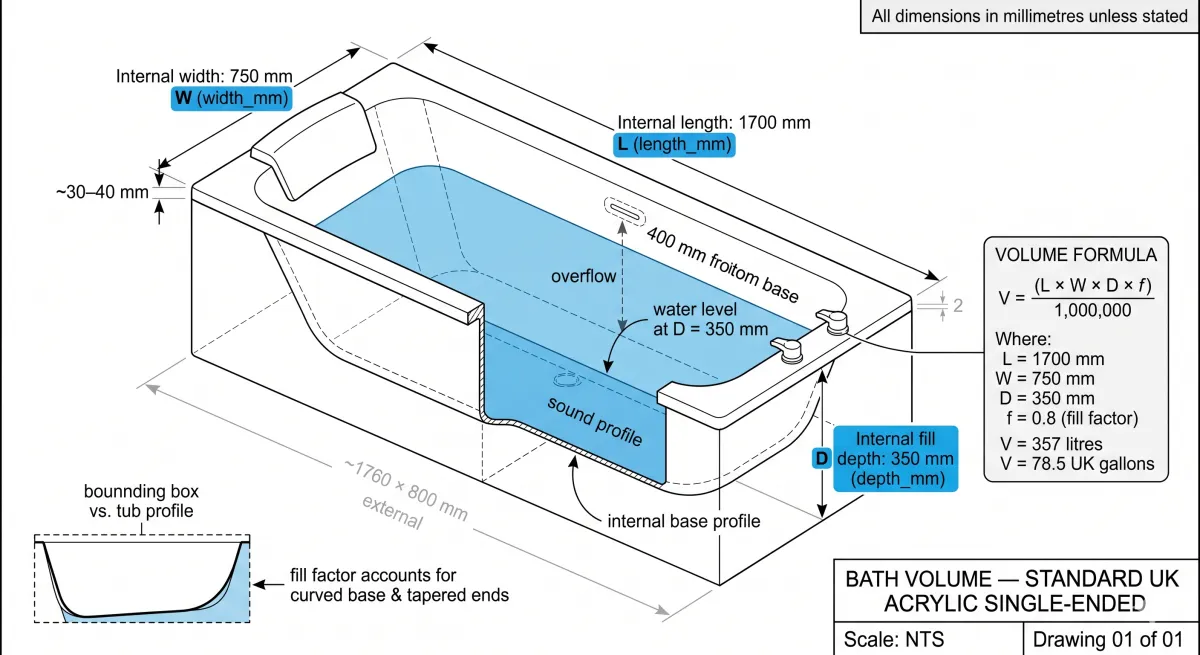
Why the fill factor matters
A bath is not a perfect box. Sloped ends, curved bases and the gap left below the overflow mean the real water volume is less than length × width × depth. The fill factor accounts for that: around 0.8 suits a typical single-ended acrylic bath, while a steeply tapered or slipper bath sits closer to 0.7, and a near-rectangular soaking tub closer to 0.9.
What this tool does not do
It does not replace a professional quote, factor regional pricing, assess structural adequacy, or confirm Building Regulations compliance. Those remain the responsibility of a suitably qualified designer, surveyor, or your building control officer.
What changes the real volume
Two things shift the figure most: the depth the bath is filled to, and the water a bather displaces once in. Filled to a comfortable 350 mm rather than to the overflow, a single-ended 1700 × 750 mm bath holds around 357 litres; an adult then displaces roughly 70–80 litres on entry, which is why baths are run below the rim. The internal dimensions are what the calculator needs — not the external box size, which can be 30–50 mm larger a side once rim and wall thickness are counted.
Building Regulations and compliance
Bathrooms in new work are covered by Approved Documents G (sanitation), F (ventilation), and P (electrics). Zoned IP ratings for lighting near water are mandatory. When in doubt, a pre-application enquiry to the local authority can give early clarity, which tends to be less costly than retrospective correction.
Putting the litres figure to use
The volume in litres supports three practical checks. Hot-water sizing: a full bath can draw more hot water than a small cylinder holds. Floor loading: litres roughly equal kilograms, so a 357-litre bath is about 357 kg of water before anyone steps in. Waste discharge: the volume sets how much drains through the trap and downstream pipework. Manufacturer capacity ratings assume a fill to the overflow with no bather, so they read higher than a realistic fill.
Adjusting the defaults
Every input is editable — internal length, width, fill depth and fill factor. Change any of them and the volume in litres recalculates instantly. If a default looks off for your bath, your own numbers always override it.
Using this bath volume / litres calculator alongside other BuildMetricLab tools
This calculator fits into wider bathroom planning. Use the litres figure to sense-check hot-water cylinder sizing or waste capacity, then move to the other BuildMetricLab bathroom tools as the design develops. Everything runs entirely in your browser — no sign-up, no data sent anywhere, and every formula is shown on-page so you can audit the maths.
Sources & methodology
Calculates bath water volume by multiplying the internal length, width and fill depth, then applying a fill factor that scales the rectangular volume down for the bath’s shape and the gap below the overflow. Dimensions are in millimetres; the result is divided by 1,000,000 to give litres (1 litre = 1,000,000 mm³), with UK and US gallon conversions alongside. The fill factor defaults to 0.8 for a standard single-ended acrylic bath. The optional heating-energy figure assumes raising the water from 15°C to 40°C (a 25°C rise) at the specific heat of water, 4.186 kJ/kg·K. Figures are estimates; the true volume depends on the bath’s exact internal shape.
Frequently asked questions
How accurate is the bath volume estimate?
It is a close approximation. Treating the bath as a box and trimming with a fill factor lands within a few per cent for most straight-sided acrylic baths. Steeply curved or slipper shapes vary more, and a lower fill factor narrows the gap. For an exact figure, filling through a metered tap measures the true volume.
What fill factor should I use?
Around 0.8 for a standard single-ended acrylic bath, which has mild base curvature and tapered ends. About 0.7 suits a slipper or roll-top with steeper sides, and closer to 0.9 a near-rectangular soaking tub. The factor scales the box volume down to the water the bath actually holds.
Does this replace professional advice?
No — it is a planning estimate. For decisions about hot-water cylinder sizing, floor loading, or waste and drainage design, a qualified plumber or building professional can confirm the figures against site conditions and the manufacturer’s specification.
Does the volume include the water a bather displaces?
No. The litres shown are for the empty bath at the chosen fill depth. An adult displaces roughly 70 to 80 litres on entry, so the level rises noticeably — that is why a bath is filled below the overflow rather than to the rim.
Can I enter inches or feet instead of millimetres?
Inputs are millimetres only — BuildMetricLab uses metric on UK pages by convention. The output is shown in both metric (litres, m³) and imperial (UK gallons, US gallons), so the conversion happens automatically once the bath dimensions are entered in mm. To convert from inches, multiply by 25.4; from feet, multiply by 304.8.
Spotted something off?
Calculations or display — let us know.
Related tools
Calculators from other categories that planners often reach for next.